A
A
A
San serif
Serif

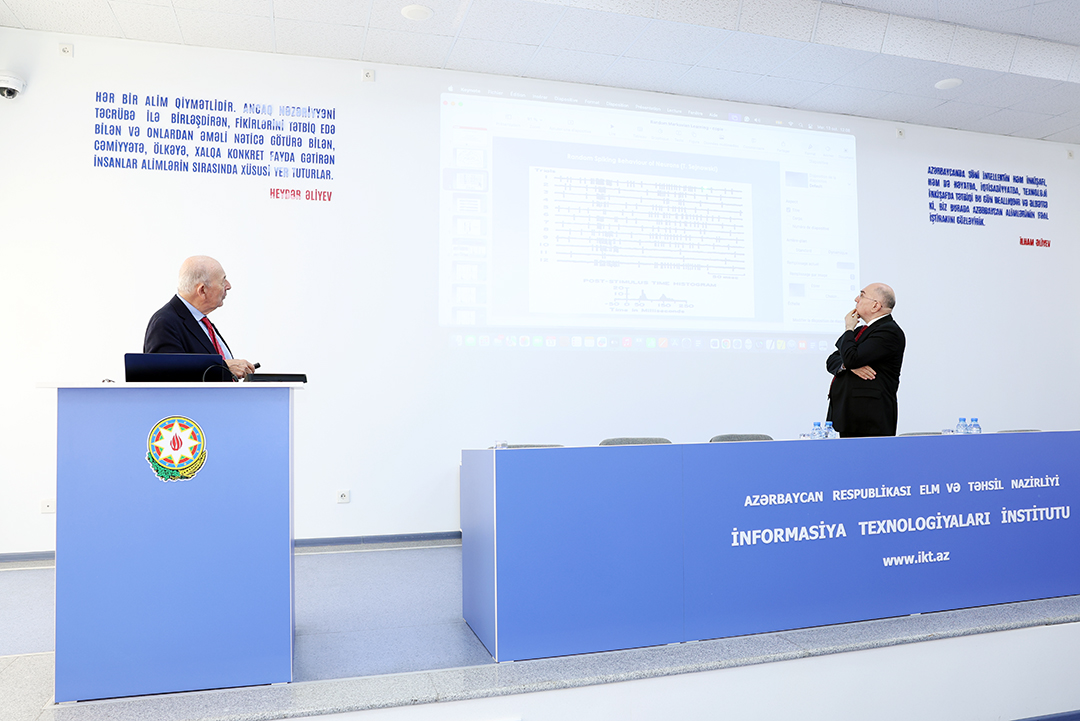
AZERTAC reports that Ramiz Aliguliyev, Head of Department at the Institute of Information Technology of the Ministry of Science and Education, delivered a presentation titled "Scientific Ethics and the CRediT System" at the Institute's Scientific Seminar.
In his speech, R. Aliguliyev noted that CRediT (Contributor Roles Taxonomy — a system for classifying research contribution roles) is an important mechanism for ensuring fairness and transparency in international academia. This system was created in 2012 at the initiative of Harvard University and the Wellcome Trust and is now widely used by major publishers such as Elsevier and Springer. The scholar stated that while the traditional approach sometimes failed to properly account for researchers' actual contributions, the CRediT system opens a new chapter in scientific ethics by precisely indicating each author's individual contribution.
The department head added that this system defines 14 distinct roles and statuses for authors involved in preparing scientific articles. These include conceptualization, methodology development, formal analysis, conducting experiments, validation of results, and other responsibilities. Thanks to this new approach, each scholar-author's specific contribution and share in a scientific work are determined in a fully transparent manner.
The CRediT system plays a vital role in academic publishing. It prevents the contributions of young scientists from being overshadowed and ensures that recognition is not attributed solely to well-known researchers. In addition, it helps prevent cases of guest authorship pursued for specific personal or institutional interests.
R. Aliguliyev stated that the CRediT system defines not only co-authors' contributions but also their specific responsibilities. Thus, if any plagiarism is detected in an article, accountability will fall not on all authors, but solely on the researchers responsible for that particular section.
It was also noted that in the future, international scientific databases and scientometric platforms will evaluate scholars based not on their publication count, but on their specific contributions identified through the CRediT system.
The seminar continued with discussions and a Q&A session.
Speaking on the topic, Academician Rasim Alguliyev, Vice-President of ANAS and Director General of the Institute of Information Technology, stated that the international CRediT system, which precisely indicates each contributor's role in scientific articles, has already become a key global standard. This system renders scientific evaluations more transparent and fair. Therefore, the widespread implementation of this innovation across all science and education institutions in our country will be of great importance for integration into the international scientific environment, as well as for objectively safeguarding copyright, determining researchers' shares in intellectual property, and advancing scientific ethical-legal relations.
© All rights reserved. Citing www.iсt.az is necessary when using news.